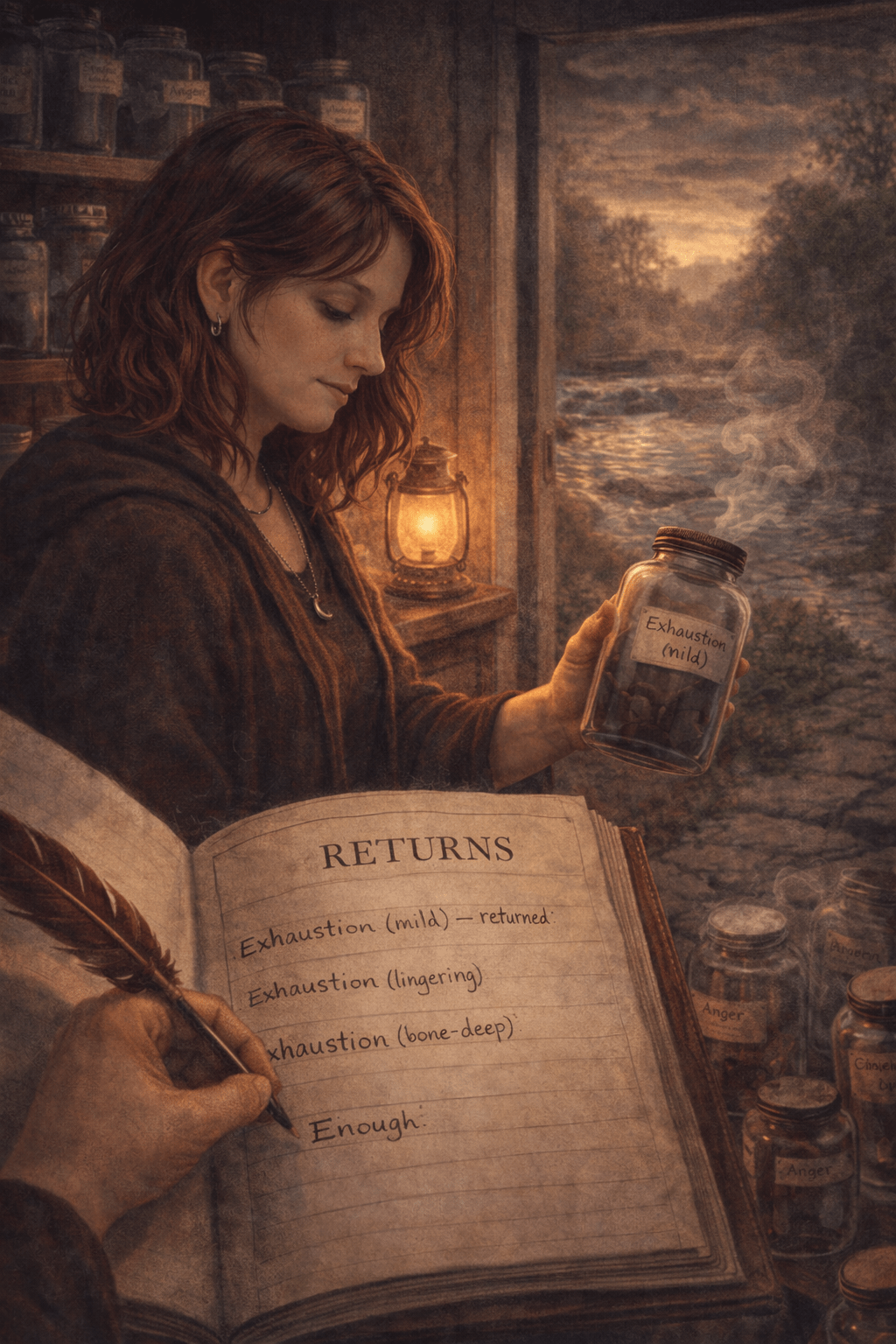
The ledger was heavier than it looked.
Most people assumed it tracked supplies (grain, linens, tools) but that wasn’t what the columns were for. The entries were smaller. Quieter. Things that didn’t clang when dropped.
Exhaustion (mild)
Exhaustion (lingering)
Exhaustion (bone-deep)
She recorded them in careful ink, one line at a time.
Every morning, she unlocked the narrow room behind the offices and took inventory. Fatigue stacked in the corners like unused furniture. Frustration hung from hooks along the wall. There were jars of resentment… some freshly sealed, others dusty and long-forgotten.
The system ran smoothly because of her.
When someone pushed through a long day, something appeared on her shelves. When they skipped rest, ignored hunger, swallowed irritation, the ledger thickened. No one liked thinking about where those costs went, so they didn’t.
They were relieved she did.
“You’re so organized,” they told her, peering in without stepping over the threshold. “I don’t know how you keep up.”
She smiled and closed the book.
Lately, the entries had been arriving faster.
Exhaustion (acute)
Exhaustion (repeating)
Exhaustion (unnamed)
The shelves bowed. The air felt tight. She found herself staying later each night, cataloging by lamplight, hands aching from careful precision.
One evening, she noticed a new section had appeared at the back of the ledger.
Returns.
It was empty.
She stared at the word for a long time. Then, carefully, she turned the page.
The room was silent. No instructions. No bell.
She chose one jar at random2026.
Exhaustion (mild), labeled in her own hand months ago.
She carried it outside, past the office doors, past the square, to the small patch of earth by the river where no one bothered to stand.
She unscrewed the lid.
Nothing dramatic happened. No sound. No shimmer. Just a soft release, like breath leaving a body that had been holding it too long. The jar grew lighter in her hand.
She went back inside.
The shelf where the jar had been was no longer sagging.
The next day, someone rested without apology.
She wrote it down.
Exhaustion (mild) — returned.
The ledger didn’t protest. The room didn’t collapse. In fact, the air felt easier.
Over the following weeks, she returned more than she cataloged. Slowly. Intentionally. She learned which costs could be set down without consequence, and which needed gentler handling.
Not everything could be returned. Some jars were sealed too tight, labels worn away. Those she left alone.
But the shelves began to clear.
One afternoon, someone asked what she did all day, now that things seemed lighter.
She considered the question.
“I keep track,” she said. “And I give back what was never meant to be carried forever.”
They nodded, as if that made sense.
That night, she added a final line to the ledger before locking the room.
Enough.
She closed the book.
The shelves held.






 Teareny Maybe
Leave a comment